AI Is Leaving the Screen
Notes by SDG ·
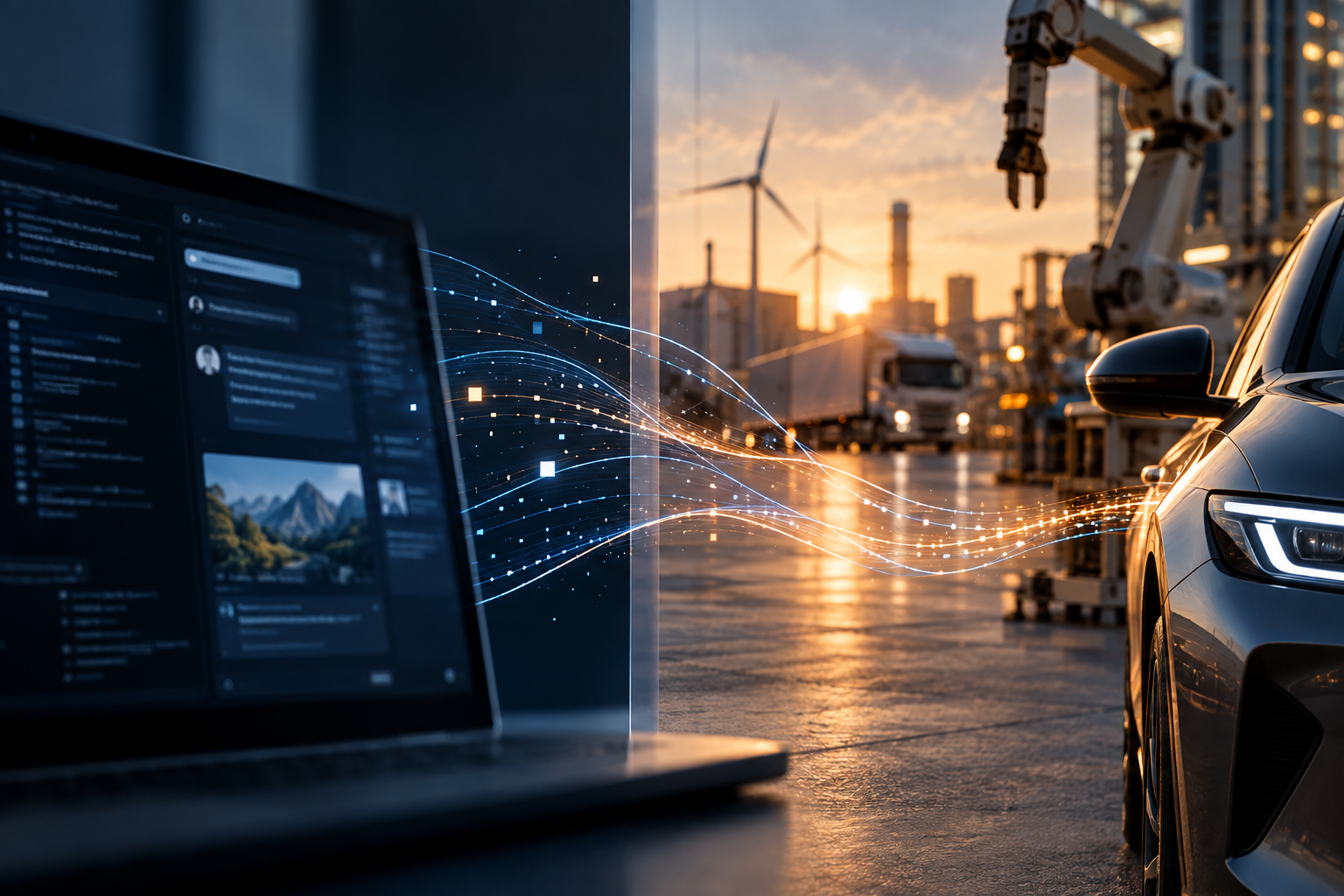
A few weeks ago, I came across QNX while trying to understand what BlackBerry actually looks like as a company today. I knew BlackBerry from the phones, obviously, but I had no idea QNX had become such an important part of the business, or that its software is now used in more than 275 million vehicles worldwide.
I learned more about it and eventually crafted The BlackBerry You Don’t See: Understanding QNX and Its Role in Physical AI.
That piece was mostly about QNX and the role a real-time operating system (RTOS) plays as AI starts moving into cars, robots, and other physical systems.
Then, more recently, a recruiter reached out to me about Archetype AI. I hadn’t heard much about the company, so naturally I started digging.
And that brought me back to Physical AI, but from a completely different direction.
QNX had made me think about the software layer that helps machines operate reliably and predictably. Archetype made me think about how those machines might actually understand what is happening around them.
And then I started wondering how these pieces could potentially fit together—and where that vision meets the messy realities of the real world.
Physical AI Is Bigger Than Humanoid Robots
When people hear “Physical AI,” they usually picture humanoid robots, self-driving cars, or warehouse machines.
That is certainly part of it, but the category is much wider.
Physical AI can also mean systems that continuously sense and reason about the physical world. That could be a robot, but it could just as easily be a factory turbine, a commercial HVAC unit, a delivery truck, or a hospital power system.
No legs or arms required.
That broader definition makes the space much more interesting—and much larger economically.
The Real World Doesn’t Speak in Text
LLMs learned from enormous amounts of text, images, audio, and code.
Physical machines generate a completely different kind of data: vibration, temperature, current draw, pressure, motion, acoustics, video, and telemetry.
A single signal often does not tell you much on its own.
A traditional monitoring system might simply say:
Temperature crossed 90°C.
A physical-world model like Archetype’s Newton is aiming for something closer to:
Temperature is creeping up, electrical draw looks slightly off, and the vibration pattern has shifted. Nothing has crossed a failure threshold yet, but the machine may be degrading.
The interesting part is that no single sensor necessarily has to scream that something is wrong. The model can potentially understand the pattern across them.
Archetype’s Newton Agents apply this kind of multi-sensor reasoning to problems such as anomaly detection and operational monitoring. It starts to look less like traditional monitoring software and more like an intelligence layer sitting on top of physical systems.
QNX and Archetype Sit in Very Different Places
QNX and Archetype are not competitors, and I haven’t seen anything suggesting that they currently work together.
But looking at them side by side helped me understand how a future Physical AI stack could come together:
- Perception: Sensors capture the physical state of the world through vibration, heat, movement, current, and pressure.
- Reasoning: Models like Newton interpret what those combined signals might mean.
- Execution Environment: Real-time operating systems like QNX provide predictable execution in safety-critical hardware.
- Action: The machine responds in the physical world.
A chatbot getting something wrong can be annoying. A robotic arm, autonomous vehicle, or medical device getting something wrong is a very different problem.
Physical AI probably cannot simply be an LLM stuffed inside a machine. The probabilistic intelligence has to coexist with deterministic software, edge computing, and safety systems designed to behave predictably.
Where the Vision Meets Industrial Reality
As exciting as this vision sounds, putting AI into physical machines is much harder than building a chatbot. The real world has a few big speed bumps:
1. Every Machine Speaks Its Own Language
Language models like ChatGPT work because human words and grammar follow standard rules. Physical sensors don't work that way. The wiggle of a wind turbine doesn’t look anything like the wiggle of a car engine. Even two identical factory machines often produce slightly different data depending on how old they are or where they sit. Building one "master model" that understands every machine out of the box is a massive puzzle.
2. Guesswork Doesn't Work in Safety
If a chatbot guesses wrong, you get a funny text answer. If a factory manager shuts down a $10 million assembly line, they need to know exactly which bolt broke—not just that an AI model feels 80% confident something is off. AI tends to be probabilistic (smart guessing), but heavy industry demands clear, exact physics.
3. AI is Non-Deterministic, but Safety Demands Predictability
Real-time software like QNX operates on split-second guarantees: if a brake or steering command is delayed by even a millisecond, the system fails. AI models are inherently unpredictable in how long they take to "think." Combining flexible AI with strict, split-second safety guarantees means the AI will likely have to stay in an advice-only role, wrapped inside hard safety rules that stop it from making dangerous choices on its own.
4. Moving Heavy Data from Old Equipment
Vibration and sound sensors generate massive amounts of data every second. Sending all that information up to the cloud takes too much internet bandwidth and costs a fortune. That means the AI has to run right on the machine itself (at the "edge"). But most factory equipment is 10 to 20 years old and doesn't have the modern computer chips needed to run AI. Upgrading all that physical equipment takes serious time and money.
Then There Is the Compute Angle
Despite these challenges, looking at this space brings me back to the AI infrastructure question.
We have already watched AI move through text, images, code, copilots, and agents. Moving into physical machines creates a whole new set of potential workloads.
In my previous AI Market Signals piece, I wrote about one of the counterarguments to the idea hat too much AI infrastructure is being built: cheaper inference can create new demand.
Physical AI may be one example of that.
Today, continuously streaming and analyzing hundreds of telemetry feeds from every machine inside a factory may not make financial sense.
But that equation changes as inference gets cheaper and as edge chips get better at running models directly where data is generated. Instead of sending every vibration reading back to a giant cloud model, more intelligence can sit near the machine itself.
If the cost of inference falls dramatically, you don’t just save money on workloads that already exist—you start making completely new workloads practical. A machine that previously relied on a few threshold alarms could potentially have continuous intelligence watching vibration, temperature, electrical draw, sound, and video together.
Then multiply that across factories, vehicles, buildings, power systems, and industrial equipment.
That is a lot of potential new compute.
And it is one reason I find the “AI infrastructure is being overbuilt” discussion complicated. Lower compute prices do not necessarily mean lower compute demand. Sometimes lower prices create demand that simply wasn’t economical before.
Where This Could Go
One thing that would make Physical AI much more interesting is seeing it spread well beyond humanoid robotics.
Factories, utilities, logistics, buildings, medical equipment, and transportation already generate enormous amounts of sensor data. If general physical-world models can extract useful information from that data without requiring a completely new model for every individual machine, the economics could get interesting quickly.
The edge is another part of this. Latency, bandwidth, security, and reliability mean a lot of physical-world inference probably cannot depend entirely on sending data back to centralized cloud infrastructure. That pulls a whole set of other companies into the story: chipmakers, edge-computing platforms, telecom providers, sensor companies, and real-time operating systems like QNX.
And then there is the question I am probably most curious about: can general-purpose physical models actually work across very different machines?
Industrial AI today is often highly specialized. One model monitors one machine for one particular failure condition. Archetype seems to be making a much bigger bet.
If a physical foundation model can learn patterns across different sensors, machines, and environments without engineers effectively starting over each time, it could change how industrial AI gets deployed.
Of course, physical industries have a habit of making technology roadmaps meet reality fairly quickly. Factories are messy. Equipment can be decades old. Sensor data isn’t always clean. Integration takes time. Safety certifications take even longer. Risk-averse plant managers move cautiously.
An impressive demo is still a very long way from a large production deployment.
The Rabbit Hole Keeps Going
Still, it is hard to ignore the direction this is moving.
The last few years have mostly been about teaching AI to understand language, images, and code.
Physical AI extends that into vibration, movement, temperature, pressure, electricity, and all the other signals machines produce.
My first trip down this rabbit hole started with QNX and the software underneath the machine.
A recruiter introducing me to Archetype AI pulled me back into it from the other side: the intelligence trying to understand the machine and the world around it.
Put those ideas together and the question becomes much bigger than who builds the best robot.
It becomes:
Who owns the layers that allow billions of machines to sense, understand, and eventually act safely?
And if cheaper compute keeps making more of those use cases economically viable, Physical AI could become another source of AI demand that barely exists today.
That seems like a space worth following.