AI running a supermarket's supply chain.
Notes by SDG ·
I came across a research paper in my latest Biweekly Retail Digest and found it very interesting
Here's what I understood.
The paper is called Flowr. It was published on arXiv (2604.05987) in April 2026. The short version: a team of researchers built a system where AI agents handle the supply chain operations of a large supermarket chain. Not a demo. An actual deployment.
I found this very interesting, so here's what I understood.
What problem were they solving?
Running a supermarket's supply chain is a lot of coordination. Someone needs to figure out what each store will need next week, check what's in stock, place orders with suppliers, follow up when deliveries are late, route stock from warehouses to outlets, and deal with problems as they come up.
Most of this still happens manually — emails, spreadsheets, phone calls. At one store that's manageable. At hundreds of stores with thousands of products and dozens of suppliers, it becomes really hard to keep up.
What they built
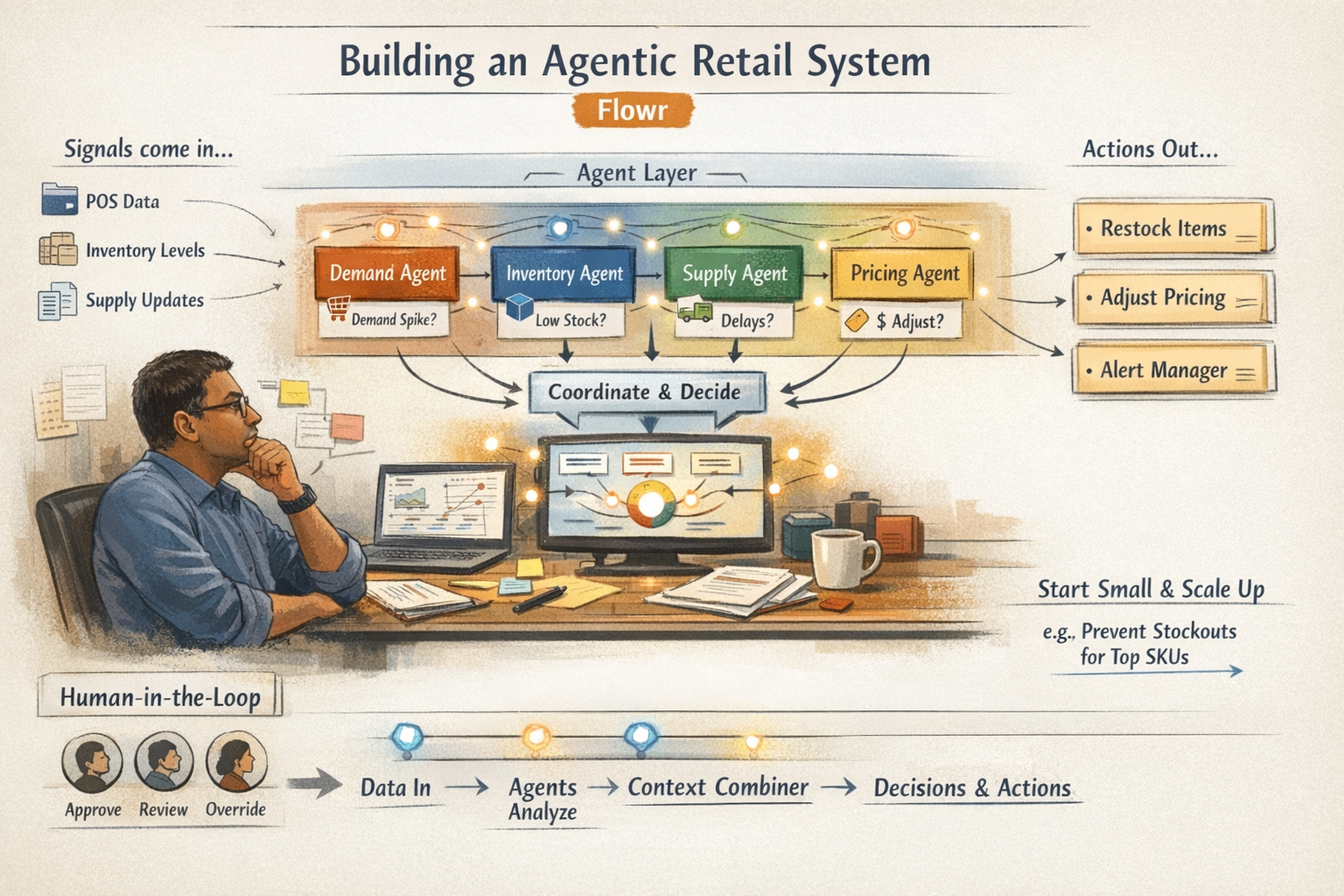
Instead of one AI trying to do everything, they built six specialized agents — each one responsible for one part of the workflow.
Demand Forecasting Agent
Predicts what each store will need — using sales history, seasonality, local patterns.
Inventory Monitoring Agent
Watches what's in stock across all outlets. Flags what's running low.
Procurement & Ordering Agent
Decides when to order and from which supplier. Creates purchase orders.
Supplier Coordination Agent
Talks to suppliers — sends orders, handles delays, manages substitutions.
DC Replenishment Planning Agent
Figures out how stock should move from warehouses to stores.
Exception & Alerts Agent
Catches problems before they hit customers. Flags things that need a human.
Each agent passes what it knows to the next one. So the Procurement Agent isn't ordering blind — it already has the demand forecast and the current stock levels before it does anything.
The AI part — plain English
They didn't just wire up ChatGPT to a spreadsheet. Each agent runs on a language model that was fine-tuned specifically for its job in retail supply chain. There's also a central model that coordinates the whole thing — deciding what runs next and in what order.
Fine-tuning basically means training the model on data from this specific domain so it understands things like supplier lead times, perishable product constraints, and outlet-specific demand — rather than just knowing about supply chains in a generic textbook sense.
Humans are still in the picture
The system isn't fully autonomous. Supply chain managers supervise it, validate decisions at key points, and can step in when needed. The researchers built checkpoints into the workflow specifically for this.
What changes is what humans actually do day-to-day. Before: manually executing tasks (placing orders, sending emails, updating trackers). After: reviewing what the agents did, handling the tricky exceptions, making calls on things the system isn't sure about.
They tested it for real
They didn't just describe a system — they deployed it with an actual large supermarket chain. The environment had hundreds of outlets, perishable products, multiple suppliers with different reliability levels, and demand that varies by location.
The results they report: less manual coordination work, better stock alignment across outlets, and fewer stockouts because the Exception Agent catches problems before they reach the shelf — not after.
That last part is the bit I found most interesting. Reacting to a problem after it's happened is just damage control. Catching it before it hits customers is a genuinely different capability.
Source: Flowr — Scaling Up Retail Supply Chain Operations Through Agentic AI in Large Scale Supermarket Chains · arXiv: 2604.05987