AI Strategy Starts with Decisions, Not Technology
Notes by SDG ·
Every boardroom seems to be having the same conversation right now: What’s our AI strategy?
Unfortunately, many organizations start in the wrong place. They evaluate models, copilots, and vendors before asking the most critical question: How should work and decision-making actually change because AI exists?
Two major trends are reshaping how we need to think about this.
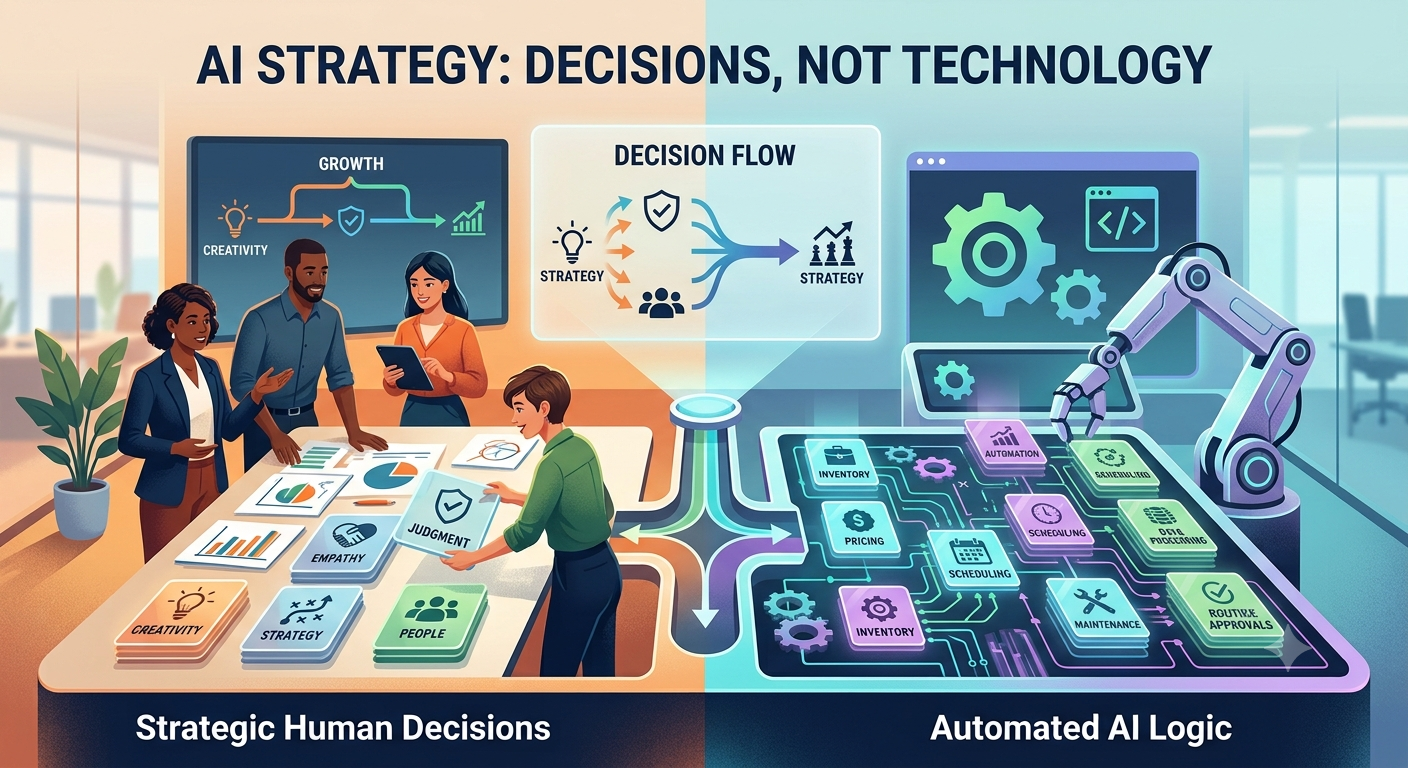
First, a large-scale study of AI-powered vending machines found that limiting employees ability to override AI recommendations actually improved inventory optimization without hurting sales. The takeaway isn't that AI should replace people; it's that companies must be intentional about which decisions belong to machines and which require human judgment.
Second, while AI adoption is skyrocketing, many enterprises are struggling to show meaningful ROI. The bottleneck isn't the technology. It’s fragmented data, disconnected systems, weak governance, and outdated operating models.
When you connect these two points, the reality becomes clear: AI strategy is an operating model strategy, not a technology strategy.
Every Organization Is a Decision Factory
No matter the industry, every organization exists to make decisions. Some are strategic, but most are operational and repetitive: Should inventory move? Should an invoice be approved? Should a customer receive a refund?
Thousands of these choices happen every day. Yet, many employees spend their time gathering data, reviewing routine reports, and moving information between systems just to make or approve these minor decisions. This consumes massive amounts of human effort without creating any real competitive advantage.
That’s where leaders ask the wrong questions. They start with:
- Which model should we use?
- Which platform should we buy?
- Which copilots should we give employees?
Those matter, but they shouldn't come first. Instead, leaders need to map out their decisions and categorize them:
- Which decisions should always be automated?
- Which decisions must remain human?
- Which decisions should be a collaboration between both?
In the vending machine study, the AI wasn't "smarter" than the humans. It was just better suited to process thousands of routine variables in real time. By offloading that grind, employees became more valuable because they could focus on situations requiring judgment, creativity, negotiation, and empathy. AI isn't changing the importance of people, it’s changing where they create value.
Why So Many AI Initiatives Stall
If AI models are improving every few months, why are companies struggling to see returns? Because they are deploying cutting-edge AI into workflows designed decades ago.
When employees still have to manually gather data or review low-value, automated choices, AI just becomes an extra step in an already bloated process. The technology works, but the workflow doesn't. This is why so many AI pilots look impressive in a demo but deliver modest business outcomes.
The Fix: Stop trying to layer AI on top of old processes. Instead, ask: "If we were designing this workflow today with AI available from day one, what would it look like?"
In an AI-first workflow, the system continuously monitors operations, automatically handles routine tasks within defined guardrails, and flags meaningful exceptions. People stop reviewing every single transaction and start solving unusual problems, coaching teams, building relationships, and driving strategy.
Governance Is the Accelerator, Not the Brake
People often treat governance as the bureaucracy that slows AI down, but the opposite is true. Strong governance allows you to automate more because the boundaries are clear.
Without clear answers to who is accountable and where AI can act independently, organizations hesitate to trust the system. As a result, every recommendation gets double-checked, workflows slow down, and ROI plummets. Trust is what enables scale, and governance is what builds trust.
Leadership’s New Responsibility
For decades, leadership was about optimizing people, processes, and technology. Today, a new dimension has emerged: decision allocation.
The organizations that win with AI won't succeed just because they have access to better models and those are becoming a commoditized utility. The real winners will be the companies that design work around the complementary strengths of people and intelligent systems.
Success shouldn't be measured by the number of AI tools you deploy, but by how much better your organization makes decisions. AI strategy is decision strategy. Get that right, and the technology becomes a true accelerator rather than a costly experiment.