Make Catalogs "Shoppable"
Notes by SDG ·
I came across Choice AI in one of xNoiz’s OpenAI digests recently. It was described as a system built by Japan’s TRUSTBANK to help users discover Furusato Nozei gifts by navigating thousands of options using AI.
Furusato Nozei is a Japanese "hometown tax" program where taxpayers donate to municipalities in exchange for tax deductions and thank‑you gifts of local specialties. many donors find the program difficult to navigate, given the sheer number of municipalities and the enormous catalog of thank-you gifts
Choice AI uses multiple AI agents, each with a clear role, working together to guide a user from intent to a final recommendation and this was interesting and I wondered how this could fit in an RCG scenario to make catalogs more shoppable instead of searchable.
I explored how this kind of system could apply to retail by brainstorming with my AI teammates 😊 and breaking the idea down step by step.
Most retail AI today is just a fancy UI on top of basic filters or a single bot like customer recommendations. It breaks the moment a customer says, "I need an outfit for a summer wedding in Tuscany that hides my midsection but stays under $300." By treating discovery as a multi-agent workflow rather than a single chat response, we can actually handle that complexity.
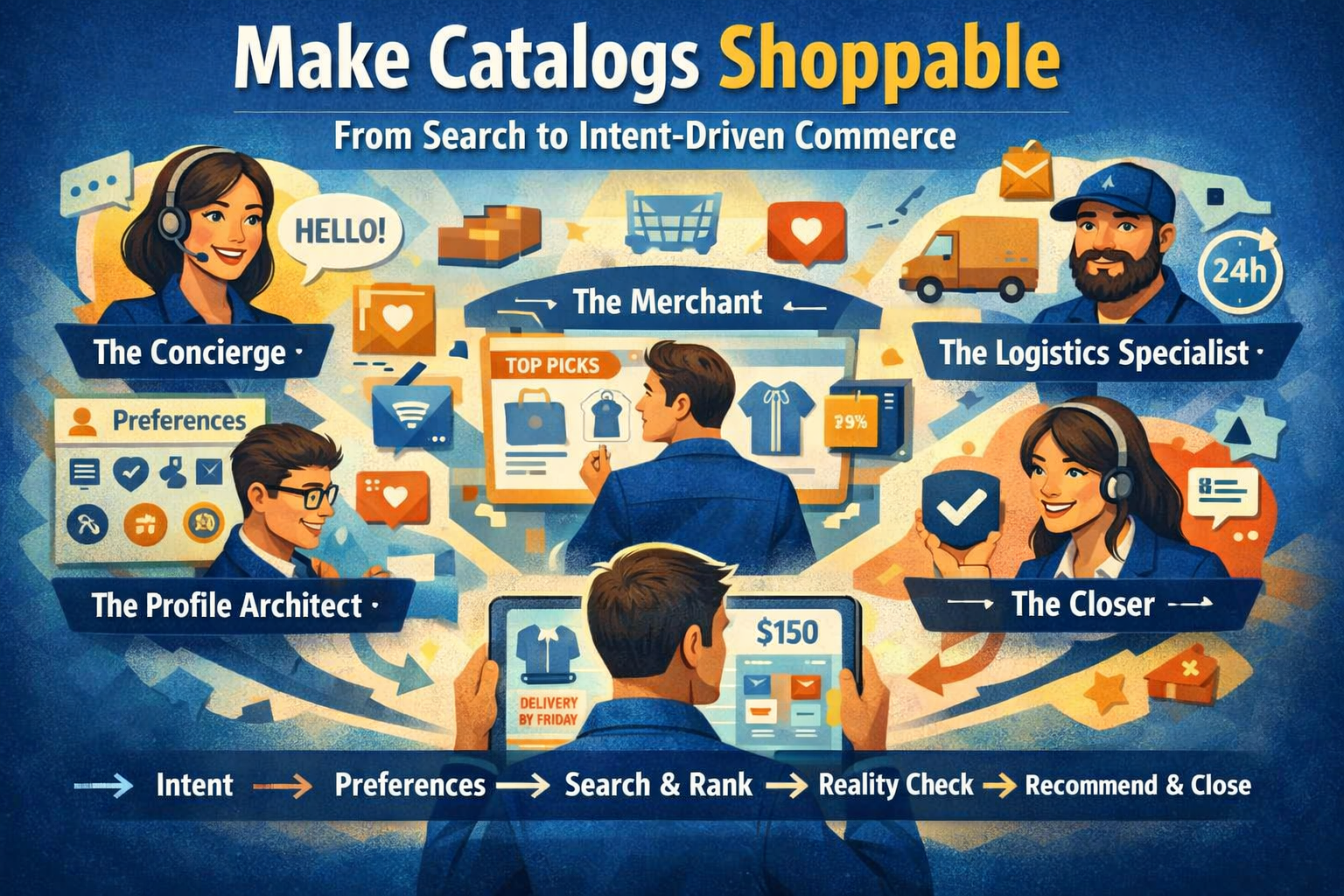
Here’s an idea on how "agents" could be mapped to a real retail environment:
- The Concierge: Handles the vibe. It manages the conversation and knows when to stop selling and start listening.
- The Profile Architect: Not a cookie. It extracts real intent (size, style, dietary restrictions) from the chat and updates the user’s "DNA" in real-time.
- The Merchant: This agent lives in the catalog. It doesn't just find "blue shirts"; it ranks them based on what’s actually in stock, what has the best margins, and what’s trending.
- The Logistics Specialist: The "reality check" agent. It verifies if that dress can actually get to your door by Friday before the AI even recommends it.
- The Closer: Handles the "why." It explains why a product fits the user’s criteria and applies the right loyalty discounts to seal the deal. (Why builds Trust and Trust drives AI adoption)
Why This Works Better Than “One Chatbot”
A single chatbot response can sound smart, but retail is not just conversation. Retail is rules + constraints + systems:
- What’s actually in stock?
- What can ship to this ZIP code?
- Which promo can be applied?
- Is the recommendation compliant with ad rules?
- Can the customer return it easily?
Breaking the job into agents makes the system more reliable and easier to control.
A Simple Example: One Customer Journey, Multiple Agents at Work
Scenario:
A shopper is looking for a birthday gift for their spouse. Budget is around $150. The gift needs to arrive before Friday.
Step 1: Conversation starts
The Concierge asks a few focused questions instead of showing products right away.
Who is it for? Any style preferences? When do you need it by?
Step 2: Intent becomes structured
As the shopper answers, the Profile Architect turns the conversation into structured data:
- Occasion: birthday
- Budget: ~$150
- Style: casual, not flashy
- Delivery deadline: Friday
- Past signal: prefers easy returns
This profile updates in real time as the conversation continues.
Step 3: Products are shortlisted
The Merchant searches the catalog and ranks products that match the profile.
It filters out low-inventory items, deprioritizes poor-margin SKUs, and boosts popular options that fit the style and price range.
Step 4: Reality check before recommending
The Logistics Specialist removes anything that cannot arrive by Friday.
If a top item is delayed, it suggests a close alternative that can be delivered on time.
Step 5: Recommendation and explanation
The Closer presents 2–3 options, explains why each one fits the shopper’s needs, and applies any eligible loyalty discount.
At no point does the shopper feel overwhelmed, and the system never recommends something that can’t actually be fulfilled.
How This Could Be Built Using Microsoft Retail Agents (Conceptual Mapping)
The architecture above is a conceptual design. I have not implemented or tested this end-to-end using Microsoft products. What follows is one possible way this could be approached based on publicly available information on Microsoft retail agent capabilities.
This is meant as an architectural thought exercise, not a reference implementation.
The Concierge → MSFT Brand Agents + Personalized Shopping Agent
- Brand Agents are positioned as shopping assistants that speak in a retailer’s voice and guide shoppers through discovery.
- Personalized Shopping Agent (preview) is described as a Microsoft-managed, headless agent you can embed into websites or customer apps for conversational shopping and recommendations.
Conversations that Convert: Copilot Checkout and Brand Agents | Microsoft Advertising
Personalized Shopping Agent in Copilot Studio (preview) - Microsoft for Retail | Microsoft Learn
In plain terms: this is your “front door” agent.
The Profile Architect → Personalized Shopping Agent + your customer data
The Personalized Shopping Agent is designed for contextual interactions and recommendations, and the typical next step is hooking it to customer context (without stuffing PII into prompts).
This is where you build your structured “customer DNA” object: sizes, preferences, budget bands, brand affinity, etc.
The Merchant → Catalog Enrichment Agent + retrieval + ranking rules
Microsoft’s Catalog Enrichment Agent (preview) is built to autonomously manage and enrich product catalogs, improving data quality for downstream experiences.
This matters more than people think. If your product data is messy, your shopping agent will either underperform or recommend the wrong thing.
A practical flow here is:
- Use Catalog Enrichment to improve product attributes and descriptions.
- Use search + vector retrieval to pull candidates.
- Apply re-ranking rules for margin, trending, promotions, etc.
Catalog Enrichment Agent in Copilot Studio (preview) - Microsoft for Retail | Microsoft Learn
Microsoft releases new agentic AI capabilities to...
The Logistics Specialist → Store Operations Agent + connectors to inventory/fulfillment
Microsoft’s Store Operations Agent (preview) is described as a managed agent in Copilot Studio that can integrate with Dynamics 365 and third-party systems via connectors.
Even though Store Ops is often framed for employees, the same idea applies: connect agents to inventory, shipping status, store pickup, and policy systems so recommendations pass a “reality check.”
Store Operations (preview) - Microsoft Copilot Studio | Microsoft Learn
The Closer → Copilot Checkout + explanation layer
Microsoft’s Copilot Checkout is positioned as a way to complete purchases inside Copilot shopping experiences, reducing friction while keeping the merchant as merchant of record.
Combine that with an explanation/compliance step:
- Explain why the top 3 choices match the shopper’s criteria.
- Apply eligible loyalty or promotional logic.
- Keep language consistent with brand rules.