Should We Use AI to Write?
Notes by SDG ·
The question itself already assumes a problem.
Not “What are you trying to say?”
Not “Do you have something worth sharing?”
But “Did a machine help you say it?”
That framing misses the real shift happening.
Most people don’t lack ideas.
They lack time, structure, and momentum to turn those ideas into clear writing.
AI didn’t invent that gap. It just started filling it.
Writing Has Always Been a Bottleneck
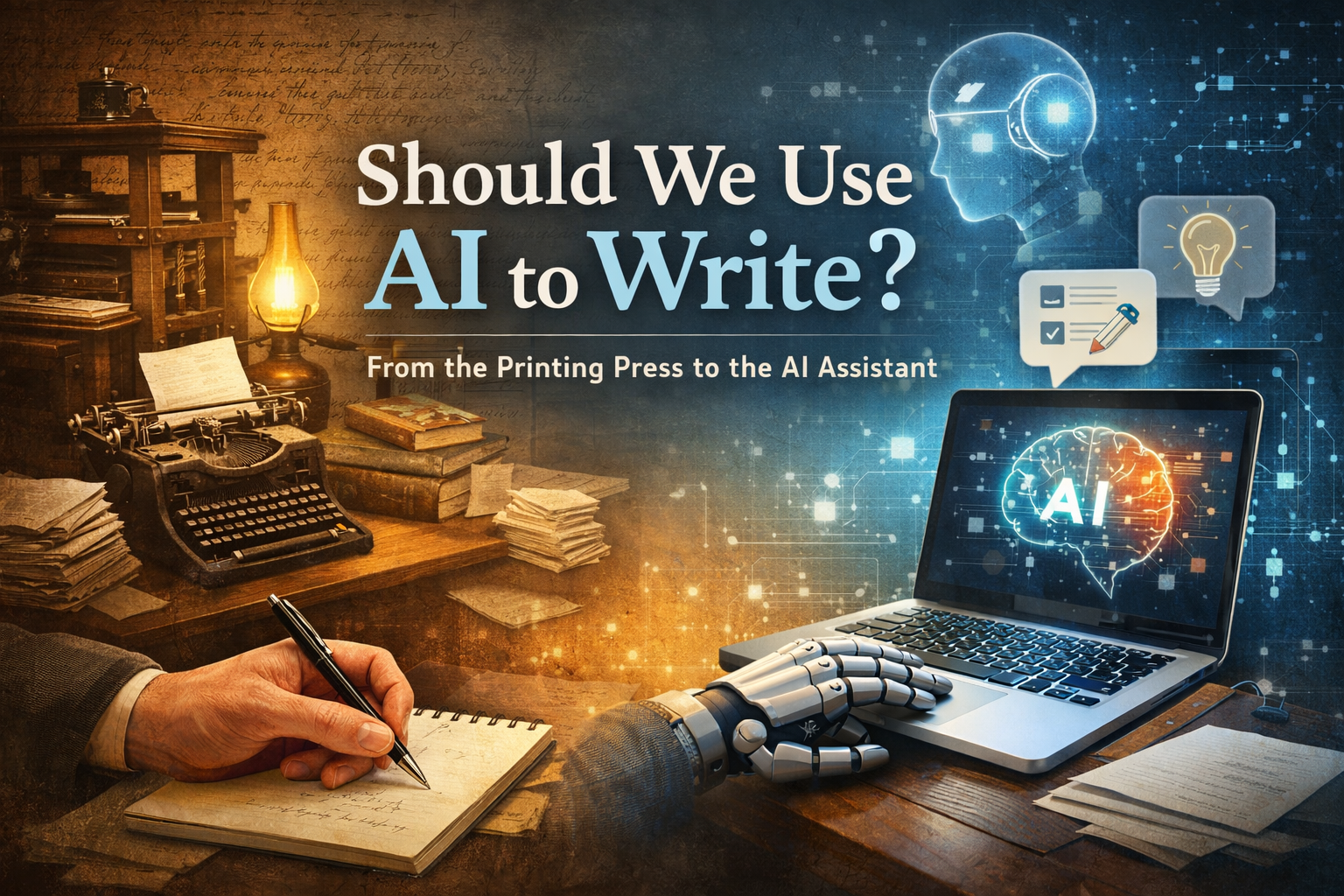
Throughout history, technology has quietly widened who gets to participate in thinking, creating, and sharing.
- The printing press didn’t make ideas weaker. It multiplied them.
- Typewriters didn’t dilute authorship. They sped up iteration.
- Word processors didn’t remove thinking. They removed friction.
- Spell-check and grammar tools didn’t kill writing skill. They raised the floor.
Each time, there was anxiety.
Each time, the fear wasn’t really about quality.
It was about control.
Who gets to publish.
Who gets to sound articulate.
Who gets to be taken seriously.
AI is the next chapter in that same story.
The Real Mistrust Isn’t About AI
There is mistrust around AI-generated writing. And some of it is justified.
But the mistrust usually comes from one pattern:
People are using AI to write, not writing with AI.
There’s a difference.
Using AI to write means outsourcing thinking.
The output sounds polished but hollow.
No personal angle. No lived experience. No point of view.
Writing with AI is different.
It looks like:
- Starting with a rough, human thought
- Using AI to structure, refine, challenge, or compress it
- Iterating until the voice still feels like yours
In that flow, AI is not the author.
It’s the editor, sparring partner, and accelerator.
AI Doesn’t Replace Thinking. It Exposes It.
Bad writing with AI usually comes from bad thinking without it.
AI doesn’t magically create insight.
It amplifies whatever you bring to the table.
- Clear thinking becomes clearer.
- Vague thinking becomes more obviously vague.
- Strong POVs get sharper.
- Empty ideas get exposed faster.
That’s uncomfortable. Which is why the resistance feels emotional, not technical.
What We’re Actually Debating
When people ask, “Should we use AI to write?”
They’re often really asking:
- Who deserves an audience?
- Who gets to sound articulate?
- Who gets to publish without spending hours polishing prose?
AI lowers the cost of expression, not the cost of thinking.
And that’s a good thing.
Because the world doesn’t need fewer ideas shared well.
It needs more people willing to share what they already have in their heads.
My Take
AI shouldn’t replace your voice.
It should remove the friction that kept your voice stuck in draft form.
Write first.
Think clearly.
Then use AI to help you say it better, faster, and more consistently.
That’s not cheating.
That’s evolution.
And this logic doesn’t stop with writing.
The same pattern is already playing out across all AI-generated content — images, audio, video, code, research, even strategy. When AI is used instead of intent, taste, or judgment, the result feels generic. When it’s used with human direction, it becomes a force multiplier.
Like every tool before it, AI doesn’t decide the quality of what’s created.
The human behind it does.
Avoiding thinking is the real risk.
AI just makes it easier to notice.