The AI Agent Is Easy. Explaining the Bill Is Hard.
Notes by SDG ·
Enterprise software spent decades perfecting per-user pricing. Then AI agents arrived and inconveniently started doing work without needing a user account.
I was reading the next set of reports from my AI news system when I noticed something odd.
Every major enterprise software company now seems to have agents. They can answer questions, resolve service cases, handle HR requests, automate workflows and, according to the marketing material, return several hours of our lives every week.
That's great and I have already made plans for the extra time, most of which involve creating more work for myself. :)
But beneath the product announcements, another competition is taking shape. Microsoft, Salesforce, Workday and ServiceNow are not only trying to build useful AI. They are trying to answer a much more uncomfortable question:
How do you charge for software that increasingly performs the work instead of merely helping a person perform it?
The old SaaS model had an elegant answer: count the people, assign the licenses and send the invoice.
AI is making that math much less elegant.
AI breaks the logic of per-seat pricing
Traditional software is largely priced around access. If 5,000 employees use a platform, the customer buys some version of 5,000 seats. More employees generally means more usage and more value, so headcount works as a convenient proxy.
An AI agent breaks that relationship.
One agent might complete ten tasks a month or ten million. A small team could use agents heavily, while a large licensed population might barely touch them. An agent may also replace work that previously required several people—or create new work that nobody was doing before.
Charging only by seat can therefore become disconnected from both the vendor’s cost and the customer’s value.
That leaves enterprise AI vendors experimenting with several models at once:
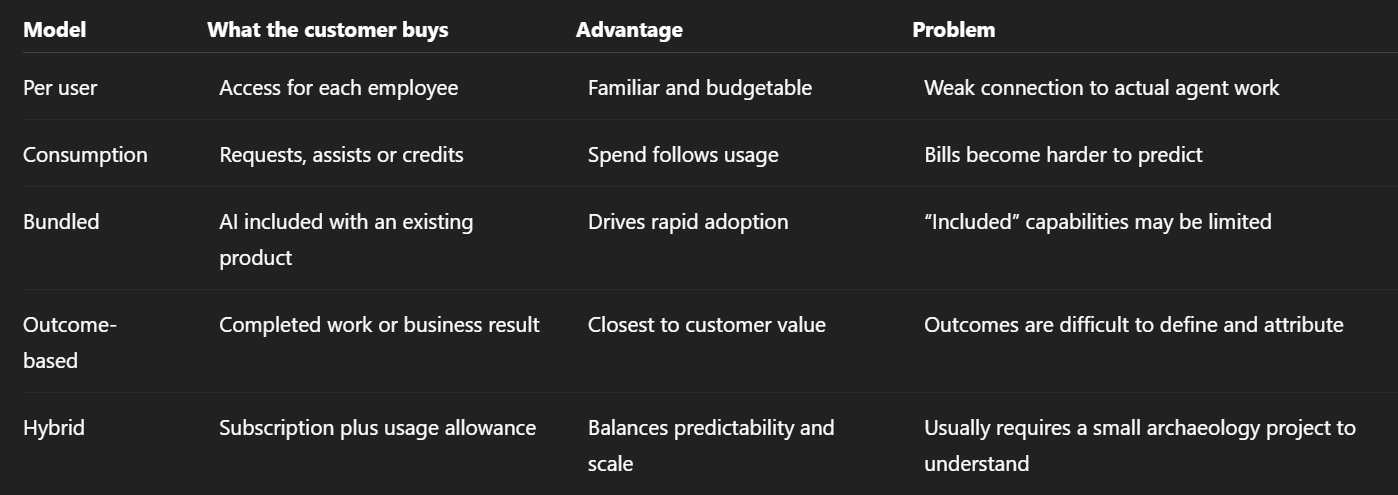
The interesting part is that the largest vendors are already combining these models rather than selecting just one.
Microsoft is using free as the front door
Microsoft 365 Copilot Chat is now available at no additional cost with eligible Microsoft 365 plans. That gives organizations a secure, web-grounded AI entry point without first purchasing a Copilot license for every employee. But richer Microsoft 365 Copilot capabilities are sold as a $30-per-user monthly license, while some custom agents used through Copilot Chat are metered. (Microsoft’s Copilot pricing, Microsoft Learn on Copilot Chat agents)
This is a clever distribution strategy.
Free chat creates familiarity and lowers the barrier to adoption. The premium license adds deeper work context and integrated experiences. Metered agents allow Microsoft to charge when the system begins doing more substantial work.
In other words, the chat may be included, but the useful digital coworker still needs a cost center.
The risk for customers is assuming that “included” means the same thing as unlimited enterprise AI. It does not. The cost moves depending on whether the experience uses web context, organizational data, premium application features or metered agents.
Salesforce is turning AI into a currency
Salesforce uses consumption units across its AI and data products. Its documentation says Service Assistant can consume Flex Credits and Data 360 credits depending on the process being performed. (Salesforce Service Assistant billing)
Credits give Salesforce flexibility. Different AI actions can consume different amounts without requiring a separate price for every feature. Customers can buy a pool and use it across workloads.
But credits also introduce abstraction.
A business leader understands the cost of an employee resolving a service case. “This workflow consumed 47 credits from one pool and 18 from another” is less intuitive—particularly when the person approving the budget is not emotionally invested in becoming a specialist in enterprise-software currency conversion.
The real requirement is not merely a usage dashboard. It is translation:
How much did this AI-supported outcome cost, and was it better than the previous way of doing the work?
Without that connection, credits can measure activity while hiding economics.
Workday is trying to connect price to completed work
Workday’s Flex Credits model is especially revealing because the company explicitly contrasts it with traditional per-employee pricing. Workday says customers purchase credits in bulk and use them across agents and platform capabilities. The annual purchase preserves budget predictability, while consumption changes according to which agents are used. Most importantly, Workday describes the model as charging for work AI completes, rather than the number of employees in the organization. (Workday Flex Credits, Workday on usage-based AI pricing)
That is probably where much of enterprise AI pricing is heading: not pure pay-as-you-go, but committed annual consumption tied more closely to work performed.
Workday is also packaging Sana agents into Workday GO for midsize organizations with a fixed scope and predictable cost. (Workday GO)
This suggests two different adoption paths:
- Package AI into a predictable product for customers who want simplicity.
- Offer flexible credits to larger customers that want to shift usage among many agents.
That division makes sense. A midsize company does not want to establish an internal Center of Excellence for calculating the cost of asking payroll a question.
Replit is already pricing the AI worker
This is not theoretical for me. I have spent the last year and a half building products on Replit. The Agent does not simply suggest code. It plans features, writes code, configures infrastructure, tests the application, finds problems and tries to fix them.
It behaves less like a software tool and more like work being performed.
Replit originally charged a flat $0.25 per checkpoint. Small edits cost $0.25, while larger requests could produce several checkpoints at the same price.
That stopped making sense as the Agent became capable of working autonomously for much longer. Replit said some Agent runs could consume up to $10 of underlying resources, while the flat checkpoint system often created intermediate checkpoints that did not correspond to meaningful completed work.
Replit moved to effort-based pricing. The current model works like this:
- One build request generally produces no more than one checkpoint.
- The checkpoint captures the completed implementation, rather than every intermediate action.
- Its price is based on the time and computing resources the Agent used.
- Simple requests can cost as little as about $0.06 and typically cost less than $0.25.
- More involved requests often exceed $0.25 and can cost more than $1 or several dollars.
- Larger projects and longer conversation context can make the next request more expensive.
(Replit’s pricing announcement, Replit’s pricing recap, current Replit AI billing documentation)
Replit now also offers Free, Power and Max modes to let users trade capability for cost. Paid work requires confirmation. The usage interface shows the cost of individual checkpoints, and customers can set alerts and budget limits.
But a “request” includes more than visible code changes:
- Plan Mode can perform billable reasoning even if no code is changed.
- Automated App Testing is charged according to the effort spent testing, analyzing and correcting the app.
- Third-party AI services used behind the scenes are billed at the provider’s public API rate and deducted from Replit credits.
(Replit Agent modes, Replit App Testing)
This is one of the clearest examples of AI changing software economics. Replit is not primarily charging me because I occupy a seat. It is charging for the Agent’s effort on each piece of work.
That aligns Replit’s revenue more closely with its own cost. A complicated feature consumes more models, tools, tests and runtime, so it costs more than changing a label.
But it exposes the next pricing problem:
Effort is not the same as value.
An Agent can work very hard on the wrong solution. It can spend time debugging a problem it introduced. A small change may create enormous business value, while a technically difficult feature may be used by nobody—an experience software founders traditionally preferred to discover several months later.
Replit can measure how much work its Agent performed. Only the customer can determine whether that work was worth performing.
Credits can hide the economics
Credits, assists and checkpoints give vendors flexibility. Different actions can consume different amounts without requiring a separate SKU for every feature.
They also introduce abstraction.
A business leader understands the cost of resolving a service case or delivering a feature. “This used 47 credits, three assists and a $2.16 checkpoint” is less intuitive.
The customer needs translation:
How much did this completed outcome cost, and was it better than the previous way of doing the work?
Without that connection, credits measure activity while hiding economics. They can also become the next generation of SaaS shelfware: companies may overbuy annual credit pools that expire unused, having successfully replaced unused licenses with unused artificial intelligence.
Progress, technically.
The buyer needs a new unit of value
The industry currently prices what is easiest to count:
- Users
- Tokens
- Requests
- Credits
- Assists
- Agent effort
None of these is what the enterprise actually wants.
The enterprise wants a resolved incident, a completed employee request, a faster financial close, a qualified opportunity or a production-ready feature.
The better measurement is cost per successfully completed outcome.
For each AI workflow, I would want to know:
- Was the task completed correctly?
- What was the total cost per successful completion?
- How much human time was actually saved?
- How much review or rework was required?
- Did speed, quality or customer experience improve?
- What new risk did the automation introduce?
A person sending ten prompts is usage, not automatically value. An agent taking 40 actions is effort, not automatically success. A product team producing more code is output, not automatically a better product.
We spent the first phase of enterprise AI asking, “How many people are using it?”
The next phase should ask, “What useful work was completed, at what cost, and what would have happened without it?”
Pricing will shape how agents behave
Pricing does not merely capture value. It shapes product behavior.
Per-seat pricing encourages broad deployment. Per-request pricing rewards more interactions. Effort-based pricing aligns charges with the cost of doing the work, but can reward complexity. Outcome-based pricing encourages completion, but creates arguments about what counts as success and who deserves credit—something corporations managed perfectly well even before AI.
The likely answer is a hybrid:
- A subscription for access and budget predictability
- Included capacity to encourage experimentation
- Usage charges as agents scale
- Outcome reporting that connects consumption to business value
Replit shows us the direction. When software becomes the worker, the bill begins to resemble a labor invoice: easy work costs less, complex work costs more, and occasionally you wonder why the task took so long.
The enterprise AI race is no longer only about who builds the most capable agent.
It is also about who can explain the bill without requiring another agent to decode it.
And that may turn out to be the harder product problem.