The Year the Effort Curve Collapsed
Notes by SDG ·
There was a long phase where my ideas lived like unsent emails — drafted, refined in my head, never shipped.
Not because of a lack of intent.
Because the effort curve was a cliff.
For years I knew I wanted to build products. What I did not have was the stamina to fight tooling, frameworks, deployments, UI glue, auth plumbing, and the thousand paper cuts between thought and software.
Then two things happened almost at the same time.
In Dec 2024, Satya said agents could make traditional SaaS feel obsolete.
That sentence sat in my head like a background process.
In Jan 2025, I started learning AI agents the hard way — the classical route: notebooks, orchestration logic, things breaking for mysterious reasons, fixing them, breaking them again.
Useful. Foundational. Slow.
And then in March 2025 I discovered — Replit.
That’s when the gradient changed.
2025: From Zero to Shipping
By Dec 2025, I had:
- 4 production web apps
- real users
- real workflows
- real costs
- real feedback loops
All built on weekends.
For someone who spent years in the “I will build someday” phase, this was not progress.
This was a rewrite of identity.
The Apps Were Not Startup Ideas
Here’s the part that matters.
I did not start with:
“Let me build a startup.”
I started with:
“This is annoying. I want this to exist.”
Most of what I built was for me.
A couple were for friends who had real, immediate problems.
That changed everything.
Because the product requirements were not hypothetical.
They were:
- my own workflows
- my own constraints
- my own edge cases
- my own impatience
No PRDs.
No market research decks.
Just:
scratch → build → use → break → fix → repeat
Built for my own operating system
These apps became extensions of how I think and work:
- Tools to structure ideas that previously lived across notes, emails, and mental tabs
- Systems that turn my weekly curiosity into something shippable
- Interfaces for workflows I was manually doing with 4–5 different tools
- Agent-powered copilots for domains where I already had context
They are not products in the traditional sense.
They are:
software versions of my personal habits
Built for friends = instant product-market fit
The ones I built for friends had a different energy.
No feature debates.
Just:
“Can you make this?”
“Wait… this actually works.”
“We are using this for the real event.”
That loop is addictive.
Because you watch:
code → real-world usage
in the same weekend.
And the feedback is brutally clear:
- this is useful
- this is confusing
- this saved me hours
- this needs one more button
No vanity metrics required.
Why This Model Works
When you build for yourself:
- scope is clear
- value is obvious
- iteration is fast
- adoption is guaranteed
When you build for someone you know:
- the problem is real
- the workflow already exists
- the willingness to use v1 is high
So instead of chasing ideas…
You are capturing demand that is already present in your life.
This is a very different product strategy.
It looks small from the outside.
But it compounds.
Because each app becomes:
- a reusable backend
- a reusable auth system
- a reusable agent pattern
- a reusable deployment flow
So the next app is faster.
And the next one after that is faster.
The Mobile Wall
Web apps started flowing.
Agents started flowing.
APIs started flowing.
Mobile still sat in the “next” column.
Until Feb 2026, when Replit’s mobile flow removed another layer of resistance.
Two weeks later:
Two mobile apps ready for the App Store.
Not by becoming a full-time mobile engineer.
But by treating mobile as:
a new surface for systems that already existed
The Architecture Shift
The real unlock was this:
My products are no longer tied to a frontend.
They are:
- Intelligence → agent workflows
- Logic → APIs
- Interfaces → web, mobile, and whatever comes next
Which means I build the brain once…
…and attach new bodies to it.
The Weekend Builder Era
All of this:
- nights
- early mornings
- weekends
alongside a full-time role.
Five years ago this required:
- a team
- funding
- a roadmap
Now it requires:
- clarity
- consistency
- curiosity
The constraint is no longer engineering capacity.
The constraint is:
how many problems in your immediate world you choose to solve.
2026: The Native Chapter
Next:
Xcode + AI + APIs from my existing Replit stack
Not starting from scratch.
Just giving my existing systems a true native form.
Same brain.
New surface.
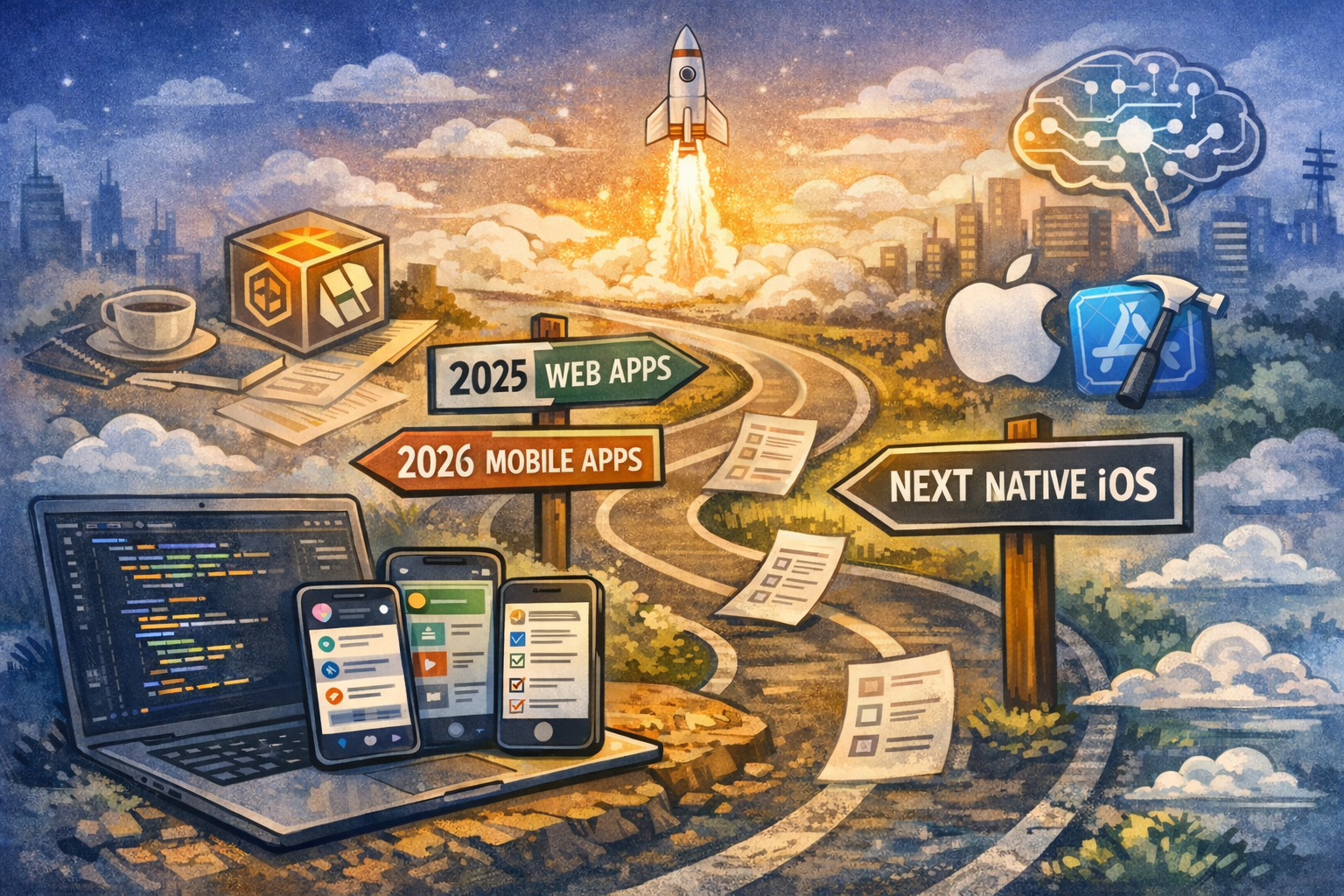
Zooming Out
2024 → Ideas
2025 → Web apps (built for my own life)
Early 2026 → Mobile apps
Next → Native iOS
The biggest change is not technical.
It’s psychological.
An idea no longer triggers:
“This will take months.”
It triggers:
“I can ship this next weekend.” 🚀