TPU vs GPU
Notes by SDG ·
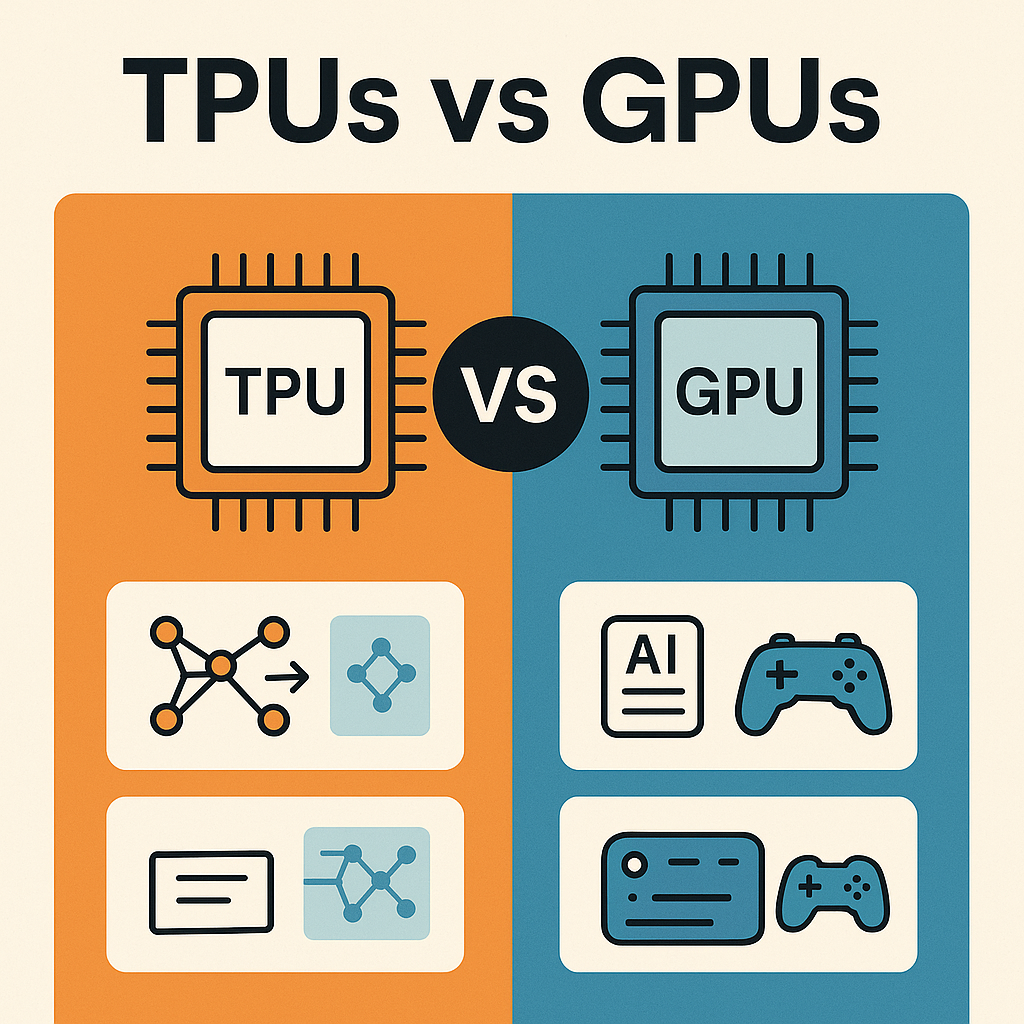
Here’s a clean, non-technical, easy-to-grasp breakdown of TPUs vs GPUs, followed by why the Google–Meta deal matters, how Amazon’s new chips fit into the competitive landscape, and finally the architectural differences that explain why TPUs can outperform GPUs on giant AI workloads.
Think of training AI like running a massive school:
- You have millions of small math problems (matrix multiplications).
- You need hardware that can solve all these tiny tasks fast and in parallel.
Both GPUs and TPUs do this — but they were designed with different “philosophies.”
🎮
GPU (Graphics Processing Unit) — The All-Rounder Athlete
GPU = extremely flexible math machine.
Originally built for video games (rendering images frame by frame), GPUs turned out to be amazing at AI because AI also needs to process huge grids of numbers.
Characteristics (in simple terms):
- Good at many different types of workloads
- Works with many frameworks (PyTorch, TensorFlow, JAX)
- Available across multiple cloud providers
- Easy for developers to use
Analogy:
A versatile athlete who can play multiple sports well.
Use cases:
- Training large language models (LLMs)
- Fine-tuning models
- Inference (running models in production)
- Gaming, video editing, simulations
Big players
Nvidia dominates this space (H100, L40S, B100 coming).
⚡
TPU (Tensor Processing Unit) — The Math Specialist
TPU = Google’s custom chip built ONLY for AI math.
Unlike GPUs, TPUs were purpose-built for one job: accelerating machine learning.
Characteristics:
- Highly optimized for matrix math, which powers neural networks
- Extremely fast for large-scale training
- Historically best when used with Google’s own ML frameworks (TensorFlow, JAX)
- Less flexible than GPUs but much more efficient for specific tasks
Analogy:
A marathon runner trained for one event — might not play basketball, but destroys everyone at long-distance racing.
Use cases:
- Training Google’s own models (Gemini, Imagen, etc.)
- Companies using JAX or TensorFlow at huge scale
- Large inference workloads inside Google Cloud
Big player:
Google (TPU v4, v5e, v5p, and v6 rumored)
🎮 GPU Architecture — Lots of Small, Flexible Cores
A modern Nvidia GPU (A100, H100, B100) has:
✔️ Thousands of small “CUDA cores”
• Each core is like a mini calculator
• They handle many types of mathematical operations
✔️ Tensor Cores
• Specialized units inside GPUs
• Accelerate matrix multiplications (the core of AI training)
✔️ Large Memory + High Bandwidth
• HBM3 memory
• Critical for feeding AI models fast
✔️ Massively Parallel
GPUs shine because they can run tons of different small computations at the same time.
🧩 Analogy: A GPU is like a kitchen with 1,000 versatile sous-chefs.
They can chop, sauté, bake — and also cook rice fast.
This flexibility is why GPUs are used for gaming, graphics, simulations, AND AI.
⚡ TPU Architecture — A Giant Matrix Machine for One Job
A Google TPU is built very differently.
✔️ 1. The Heart: A Systolic Array
This is the single biggest architectural difference.
A systolic array is like
Thousands of multiplication units connected in a fixed grid that pump data rhythmically through the array, like a heartbeat.
It is designed to do only one thing:
➤ Matrix multiply and accumulate (MatMul + Add)
Which is the core operation in:
• LLMs
• CNNs
• Transformers
• Diffusion models
✔️ 2. Minimal Control Logic
GPUs have lots of:
• Thread schedulers
• Caches
• Control logic
• Flexibility for arbitrary operations
TPUs strip nearly all of that away.
They assume:
“You are running neural networks. Period.”
This saves:
• Power
• Chip area
• Design complexity
✔️ 3. Extremely High Bandwidth Interconnect
TPU pods (clusters of TPUs) are wired together with a specialized mesh network.
This allows fast scaling across:
• 2,000+ chips
• 10,000+ chips (TPU v6 rumored)
✔️ 4. On-chip “Unified Buffer”
Instead of huge caches, TPUs use a simple on-chip memory buffer specialized for ML workloads.
🧩 Analogy: A TPU is a giant rice-cooking machine with 10,000 synchronized heating coils.
You can’t use it to sauté onions.
But the rice will finish in record time and incredibly efficiently.
⸻
🔬 SO WHY ARE TPUs SOMETIMES FASTER THAN GPUs FOR AI?
✔️ 1. Matrix multiplication is literally built into the hardware
There is no:
- Thread scheduling
- GPU-style kernel launching
- Branching logic
Everything flows in one direction, optimized for neural networks.
✔️ 2. Lower overhead = more usable performance
GPUs are flexible → they need more control logic and memory hierarchy.
TPUs are simple → almost all chip area is used for actual math.
This means:
- Higher % of theoretical FLOPs achieved in practice
- Better energy efficiency
✔️ 3. TPUs scale more cleanly across thousands of chips
Training a trillion-parameter model requires scaling across:
- 1,024 → 16,384 accelerators
TPU mesh interconnect provides:
- Predictable latency
- High bandwidth
- Fewer networking bottlenecks
This is why Google trains Gemini 1.5 on “tens of thousands of TPUs” efficiently.
❌
Where GPUs Still Win (Even Architecturally)
✔️ 1. Flexibility
GPUs can run:
- Graphics
- Games
- Physics simulations
- Video encoding
- AI training
- AI inference
TPUs cannot do these.
✔️ 2. PyTorch dominance
Most AI research happens on PyTorch → optimized for Nvidia → CUDA ecosystem is unmatched
✔️ 3. Kernel-level fine-tuning
Advanced training optimizations often need
- custom CUDA kernels
- low-level flexibility
TPUs cannot provide that fine-grained control.
✔️ 4. Inference ecosystems
GPUs support:
- TensorRT
- Triton inference server
- ONNX Runtime
- Vast library ecosystem
TPUs mainly thrive in Google Cloud.
🟨
Amazon Trainium & Inferentia Architecture (Simplified)
Trainium sits somewhere between TPU and GPU:
✔️ Has matrix math units (like TPUs)
✔️ Has multiple compute engines (more flexible than TPU
✔️ lOptimized for PyTorch 2.0 & JAX
✔️ Cheaper per token for training
Inferentia
- Uses Neuron Cores
- Designed for cheap & efficient inference
- Ideal for large-scale enterprise deployments (e.g., Alexa)
AWS message:
“Most companies don’t actually need Nvidia-level performance to run LLM inference.”
🔥
What the Meta → TPU shift means (architecture-wise)
Meta is betting that:
- TPUs = better cost/performance for giant LLMs
- TPUs = easier to scale to 10k+ chips for Llama 5 training
- TPUs = more predictable throughput
This is a direct challenge to Nvidia’s architecture dominance.
⚠️
Impact on Nvidia (with architecture context)
✔️ Nvidia still unmatched in flexibility
No TPU/Trainium can replace Nvidia for:
- Research
- Mixed workloads
- Custom ops
- General AI development
✔️ But for
massive transformer training
, TPUs are now a real alternative
Because transformer math is:
- Highly regular
- Mostly matrix multiplicatioN
This fits TPU hardware perfectly.
✔️ AWS + Google + Meta = growing anti-Nvidia coalition
All three have custom silicon.
✔️ Nvidia will pivot toward:
- Better interconnect (NVLink 6)
- Higher-efficiency tensor cores
- Hopper → Blackwell → Rubin architecture improvements
- Better software moat (CUDA, cuDNN, Triton)
📌
One-Line Summary
GPUs = Swiss Army Knife with powerful math blades
TPUs = Industrial factory machine for matrix math
Trainium = Cheaper alternative optimized for LLM workloads
Meta adopting TPUs signals the first serious architectural challenge to Nvidia’s dominance in full-scale model training.