Why and How I Built xNoiz
Notes by SDG ·
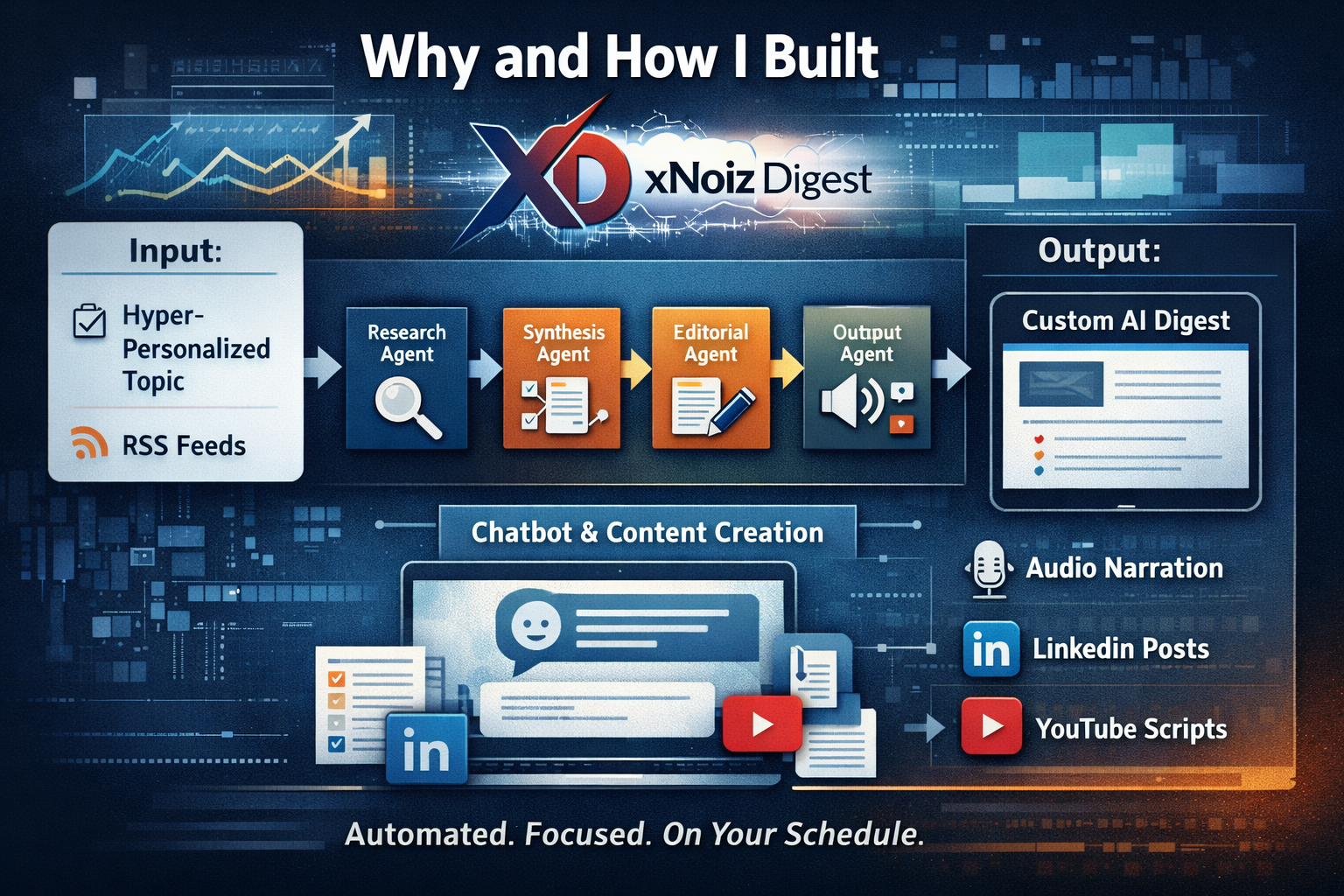
A story about information overload, curiosity, and building the tool I wished existed
If this resonates, give it a try at xNoiz Digest or follow my digests at my xNoiz Public Page . I built it for myself, but I’d genuinely love to hear what works for you — and what doesn’t.
Table of Contents
The problem I couldn’t ignore
- A quick reality check on value
- What I wanted xNoiz to be
- When and how it came together
- The xNoiz app flow (from user intent to insight)
- 4.1 Defining a hyper-personalized topic
- 4.2 Structured AI prompt generation
- 4.3 RSS feed recommendations
- 4.4 Scheduling and preferences
- 4.5 Automatic digest generation
- Inside each digest page
- 5.1 Chatbot grounded in the digest
- 5.2 One-click content creation
- The 3-agent pipeline behind xNoiz
- How xNoiz compares to existing options
- Why xNoiz exists (the honest answer)
- What xNoiz is not
A quick reality check on value
Before getting into why I built xNoiz, it’s worth grounding this in what actually happened.
Since November:
- the app created 210 digests
- The system has scanned roughly 2,000 articles
- Total OpenAI API cost so far: $25.62
That works out to:
- About ~$0.12 per digest
- Roughly 10 articles processed per digest
- And zero time spent manually skimming, filtering, or stitching things together
Getting there wasn’t automatic. I had to experiment with different LLMs, balancing cost, accuracy, and consistency depending on the stage of the pipeline — research, synthesis, and final output each behaved differently.
What surprised me was how clearly this reframed the value.
Most subscriptions charge for content access.
xNoiz ended up doing something different: quietly converting large amounts of information into decision-ready signal, on my schedule, for topics I define myself.
With that context, the rest of the story will make more sense.
The problem I couldn’t ignore
I spend a lot of time tracking AI developments and a small set of companies in my stock portfolio, especially the ones shaping AI infrastructure behind the scenes.
The issue was never access to information.
It was signal collapse.
Newsletters were broad.
Social feeds were chaotic.
Bookmarks aged badly.
So I turned to ChatGPT schedules.
I ran prompts like:
- “Weekly LLM updates from OpenAI, Google, Anthropic”
- “AI infra updates relevant to NVIDIA and hyperscalers”
- “Anything material for my portfolio companies”
I’d receive updates, extract the good parts, post them on Medium, sometimes add audio, and share on LinkedIn.
It worked… but it was fragile.
Everything lived inside ChatGPT threads.
No clean archive.
No continuity.
No way to easily go deeper on one insight.
Following my own system became work.
That’s when xNoiz started forming.
What I wanted xNoiz to be
I wasn’t trying to build a newsletter platform.
I wanted:
- Hyper-personalized digests, defined in my own words
- A system that reads dozens of sources on my behalf
- Structured summaries focused on what I need to know
- Optional audio narration
- A way to research deeper only when something matters
And I wanted it all to run automatically, on a schedule.
So I built xNoiz.
When and how it came together
I started building xNoiz on November 20, 2025, around 11 pm.
About two hours later, the first functional prototype was already working.
The rest took roughly two months, built in pockets of time late at night and in between (using Replit App) waiting for my kids to finish their ninja and gymnastics classes. No long uninterrupted sprints — just steady iteration wherever time showed up.
The first version was rough, opinionated, and imperfect.
But once the first automatic digest landed exactly how I wanted it, I knew I was done chasing information manually.
The entire thing was built end-to-end on Replit, from the first rough idea to the working product
The xNoiz app flow (from user intent to insight)
1. Define a hyper-personalized topic
You don’t pick categories.
You describe intent. You don't have to write a perfect prompt, the app will take care of it.
Examples:
- “Weekly AI infra updates relevant to NVIDIA and Hyperscalers”
- “LLM research with implications for Azure Copilot”
- Upcoming and recent crime thrillers across OTT platforms — spanning cartel dramas, morally conflicted anti-heroes, psychological power plays, and slow-burn descents into crime — for fans of Breaking Bad, Narcos, Ozark, Mindhunter"
This becomes the foundation for everything that follows.
2. Structured AI prompt generation
xNoiz converts your topic into a structured AI prompt.
You can:
- Accept it
- Edit it
- Tighten scope, tone, exclusions, or depth
This step is key.
It ensures the AI works for your thinking, not against it.
3. RSS feed recommendations
Based on the topic, xNoiz:
- Recommends relevant RSS feeds
- Lets you include or exclude them
- Combines RSS with live web search
You control the signal surface.
4. Scheduling and preferences
You choose:
- Digest frequency
- Time window (weekly, biweekly, monthly, etc.)
- Audio narration
- Precision mode
- Output depth
Then you’re done.
5. Automatic digest generation
On schedule, xNoiz:
- Scans multiple web sources (This weekly digest was generated from 23 articles)
- Pulls from selected RSS feeds
- Filters by relevance and timeline
- Produces one clean, structured digest
No repetition.
No fluff.
Just what matters.
Inside each digest page
Chatbot grounded in the digest
Each digest includes a chatbot that can:
- Answer follow-up questions
- Expand on specific sections
- Compare ideas mentioned
- Research implications using the digest as context
You’re continuing a line of thought, not starting over.
One-click content creation
From any digest, users can generate:
- LinkedIn posts
- YouTube scripts and/or audio
This replaces the manual copy-paste workflow I used with ChatGPT + Medium + LinkedIn.
The three-agent pipeline behind xNoiz
xNoiz uses a specialized agent pipeline, not one monolithic prompt.
- News Search Orchestrator
- Finds and filters web content and RSS feeds within the defined timeline.
- News Digest Editor
- Identifies patterns, removes redundancy, and structures insights.
- Reviewer Agent
- Polishes clarity, flow, and tone while avoiding hype.
Designing and Perfecting the system prompts for the first two agents took the longest time.
How xNoiz compares to existing options
Before building xNoiz, I tried almost everything available.
Here’s how it stacks up.
ChatGPT or Perplexity Schedules: Flexible, powerful prompts, Lives inside chats, no clean archive, hard to track over time
xNoiz productizes schedules into structured, searchable digests
Substack / Newsletters: Curated voices, One-size-fits-many, limited personalization
xNoiz is defined entirely by your intent
Feedly / RSS readers: Source control Still requires manual reading and synthesis
xNoiz reads, filters, and synthesizes for you
Medium Publishing reachManual creation, no automation
xNoiz turns insights into publishable content directly
xNoiz isn’t trying to replace these tools.
It fills the gap between them.
Why xNoiz exists (the honest answer)
I didn’t set out to build a product.
I set out to make my own life easier.
I built it because:
- I was already doing this manually
- ChatGPT schedules worked but didn’t scale
- I wanted clarity without constant effort
It also became one of the best learning experiences I’ve had building with modern AI.
What xNoiz is not
- It’s not a generic newsletter platform
- It’s not a social feed
- It’s not about consuming more content
It’s about knowing exactly what matters to you, automatically.
Give it a try at https://xNoizDigest.com and would love to hear what you think